
Overview
DataBlend supports sending data to Salesforce leveraging the Salesforce REST API. The data target supports the following operation modes, each suited to different integration use cases:
- Generic: Writes records to any standard or custom Salesforce SObject (e.g. Account, Contact, Opportunity, or a custom object).
- Event Message: Publishes messages to a Salesforce Platform Event. Platform Events are used to trigger real-time event-driven processes within Salesforce or connected external systems.
The Object Type is selected during data target configuration and determines which additional fields are shown.
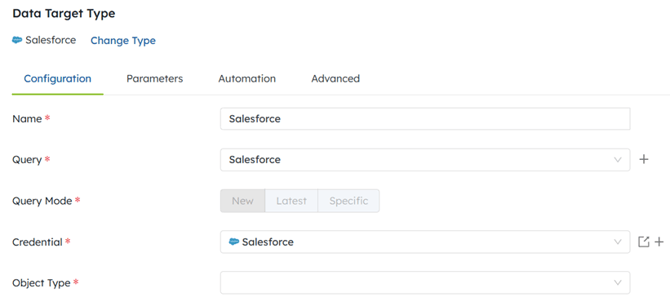
Configuration
| Field | Required / Optional | Description |
| Name | Required | A descriptive name for this data target. |
| Query | Required | Select the query that will generate the data for this target. |
| Query Mode | Required | Select New unless you have a reason to select Latest or Specific. |
| Credential | Required | Select a Salesforce credential from the list. To add a new credential, click the + icon. |
| Object Type | Required | Select the Salesforce object type from the drop-down menu. |
Additional Field for the 'Event Message' Object Type
DataBlend publishes messages to a Salesforce Platform Event by inserting an sObject via the REST API, as described in the Salesforce Platform Events Developer Guide. The Platform Event must already be defined in the target Salesforce org before publishing.
| Field | Required / Optional | Description |
| All Or None | Optional | Toggle appears when Object Type is set to Event Message. When enabled, if any event message in a batch fails, the entire batch is rolled back. When disabled, successful messages are published and only failed messages are skipped. |
Additional Fields for the 'Generic' Object Type
The following settings appear when Object Type is set to Generic. DataBlend uses the Salesforce REST API SObject Basic Information resource to create or update records, and the sObject Collections resource for batch operations.
| Field | Required / Optional | Description |
| SObject | Required | The Salesforce SObject to write records to. The drop-down is populated from the connected Salesforce credential. |
| Field | Required | The Salesforce field used to match incoming records to existing records for upsert operations. Must be a field marked as an External ID or the standard Id field in Salesforce. |
| All Or None | Optional | When enabled, if any record in a batch fails validation or processing, the entire batch is rolled back and no records are written. When disabled, successful records in the batch are committed and only failed records are skipped. Maps to the Salesforce allOrNone parameter. |
| Continue on Error | Optional | When enabled, DataBlend continues processing remaining records even if one or more records return an error from Salesforce. When disabled, processing stops at the first error. |
| One At A Time | Optional | When enabled, records are sent to Salesforce one at a time rather than in batches. Use this for operations that cannot be bulkified or when governor limits require single-record processing. |
| Delete | Optional | When enabled, DataBlend sends a DELETE request to Salesforce instead of an upsert. The query must return the Id of the records to be deleted. |
Advanced
History Retention
History Retention (Days) allows users to decide how long they want the information from their data targets to be stored. This field is optional.
Timeout (seconds)
The Timeout section allows users to determine if they would like to timeout collections taking longer than a set number of seconds to collect data.
Skip If No Records Found
The “Skip if No Records Found” button is used to eliminate sending information to Data Targets unnecessarily. Simply enable the “Skip if No Records Found” toggle. The use of this toggle is optional.
Agent
The Agent drop-down for users to select any agent they have established. This is optional.
Run As
Run As allows users to select from a drop-down list of users to run the Workflow. This is optional. Please note that Run As is only available to Admin users. If a user is set as the Run As and then demoted to a Member, the user which demoted the Run As user will instead be set as the Run As.