
Overview
DataBlend provides data targets for loading data from a query to Workday Adaptive Planning. The following are supported:
-
Import Transactional Data
-
Import Standard Data
-
Import Configurable Model Data
-
Import Cube Data
-
Import Transactions
-
-
Update Metadata
-
Update Attributes
-
Update Dimensions
-
Update Levels
-
Update Accounts
-
General Settings
All Workday Adaptive Planning data targets have the following configuration options:
|
Setting |
Required/ Optional |
Description |
|---|---|---|
|
Query |
Required |
Select the query that will generate the data for this target. |
|
Credential |
Required |
Select a configured Workday Adaptive Credential. |
|
Instance Code |
Optional |
If the user specified in the credentials has access to more than one instance of Workday Adaptive Planning, this attribute can be used to specify that the user is intending to access an instance other than their default instance. If not specified, the user's default instance will be used. |
|
URL |
Optional |
Enter script URL |
|
Workday Adaptive Planning Data Target Type |
Required |
Select one of the supported target types. |
Transactional Data Loads
Import Standard Data Settings
Basic Configuration
- From the Mode section in the data target, switch from Erase Data to Replace
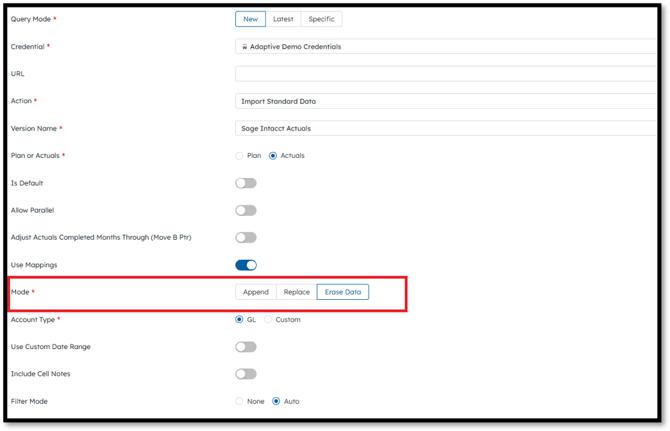
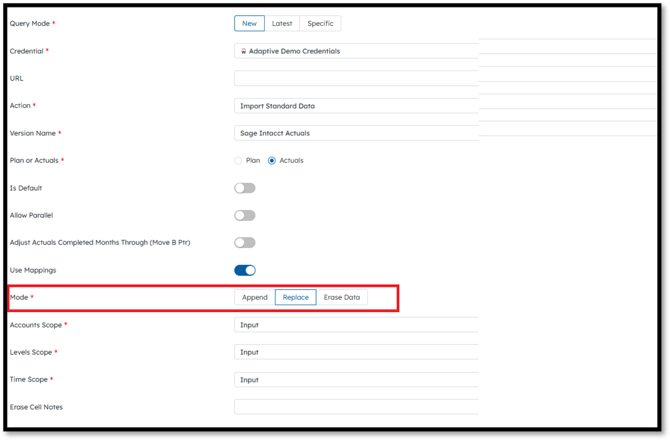
- If you only want to Replace the data in Adaptive that you are importing for (the data set in your DataBlend Query), leave everything as Input. Keep in mind this will not erase any data outside of the scope of your DataBlend query results.
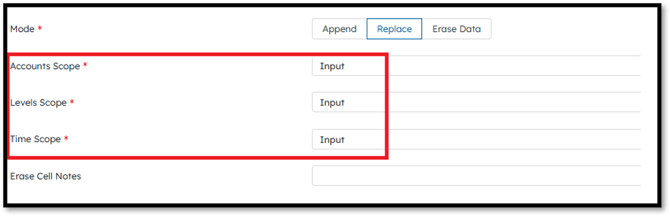
- If you want to Erase all data before importing new data, it is suggested to change the Accounts and Levels scopes to Explicit. In Explicit mode, you will need to choose which Account groups and Levels you want to erase. Click the Add button to choose the appropriate values:
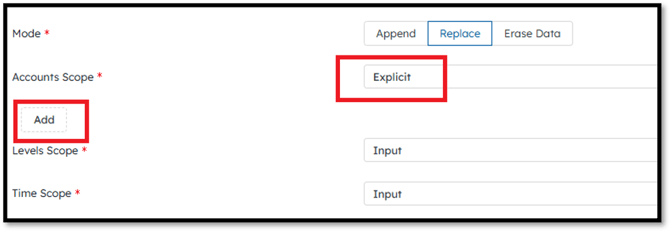
- If you want to erase the entire set of Income Statement accounts for example, you will need to add each Root Account group and toggle Include Descendants to True:
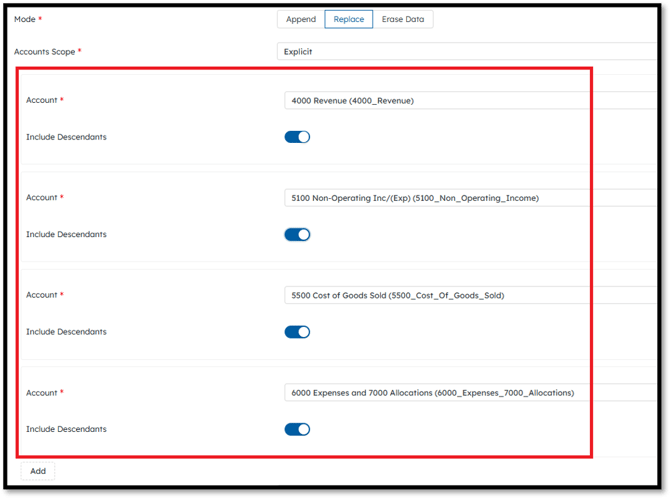
Alternatively, you can pick and choose any sub-accounts you want to include or exclude when erasing data on import.
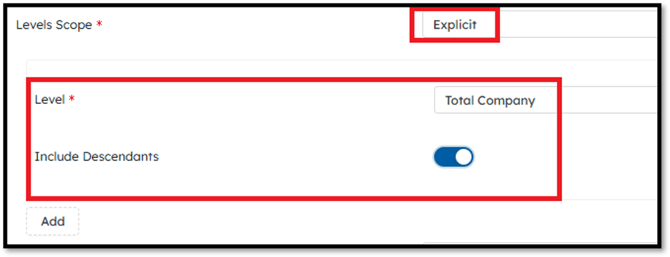
- Levels Scope is similar in that you will need to choose the Level(s) you want to include with the Erase. You could just choose the Top Level and Include Descendants, or pick and choose the individual levels you want to erase.
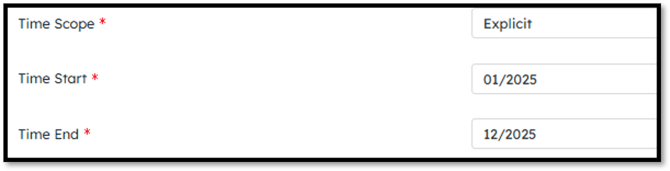
- Time Scope can be left to Input mode if you only want to erase for the time periods you are importing for (recommended), but if you want to choose the Time Range you want to erase you can use Explicit mode to do that.

There is also a Version mode if you want to erase for all Time Periods within the Version you are importing into:

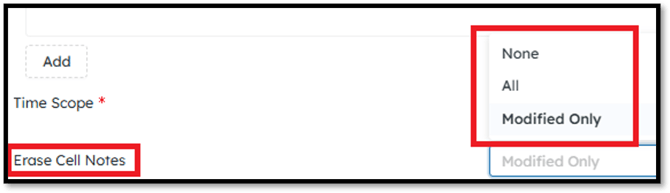
- Lastly, Erase Cell Notes is Optional to include. Typically this will be left blank, but if you want to Erase Cell Notes, you can either choose:
- All - Erase all cell notes within the scope or
- Modified Only - Erase cell notes for cells within the scope that are modified by the import. This includes previously empty cells that have facts imported into them, and cells whose facts are cleared:
Queries which provide data for the Import Standard Data target must provide the following columns
|
Account |
Level |
Split Label |
Month 1..n |
Other columns may be included between Split Label and the Month headers, if the Workday Adaptive Planning configuration requires them.
Import Configurable Model Data
Basic Configuration
The query columns must match the columns configured in the Workday Adaptive Planning sheet. If DT errors with error message Missing required field(s): "Is Split Child Row" add this field to the query as empty string.
Import Cube Data
Basic Configuration
The query columns must match the columns configured in the Workday Adaptive Planning sheet.
Import Transactions
Transactions can be deleted prior to new data being loaded. The deletion can be done based on date range, transaction type or both.
If you do not wish to delete transactions prior to loading, then set
-
Delete By Date Range = “false”
-
Delete Transaction Types= blank
|
Setting |
Description |
|---|---|
|
Delete By Date Range |
Set to “true” if transactions should be deleted based on date range. Set to “false” if transactions should not be deleted based on date range. If transaction type is not specified, all transactions given for the date range will be deleted. |
|
Custom Date Range |
Only if Delete By Date Range is true. If “false”, the date range is determined from the data to be loaded. If “true”, the user must enter the dates from which transactions will be cleared. |
|
Delete Transaction Types |
Select one or more transaction types from which to delete transactions. If no date range is specified, all transactions of the specified types will be deleted regardless of their dates. |
The query columns must match the Workday Adaptive Planning transaction field configuration.
Advanced
To learn more about Workday Adaptive Planning API requirements, please visit Login. Simply login to your Workday Adaptive Planning account, click the question mark in the upper right corner, and navigate to API documentation.
History Retention
History Retention (Days) allows users to decide how long they want the information from their data targets to be stored. This field is optional.
Timeout (seconds)
The Timeout section allows users to determine if they would like to timeout collections taking longer than a set number of seconds to collect data.
Skip If No Records Found
The “Skip if No Records Found” button is used to eliminate sending information to Data Targets unnecessarily. Simply enable the “Skip if No Records Found” toggle. The use of this toggle is optional.
Agent
The Agent drop-down for users to select any agent they have established. This is optional.
Run As
Run As allows users to select from a drop-down list of users to run the Workflow. This is optional. Please note that Run As is only available to Admin users. If a user is set as the Run As and then demoted to a Member, the user which demoted the Run As user will instead be set as the Run As.
Schedule & Presets
Link to Schedule and Presets
Metadata
Update Levels
To Update Levels and their Attributes in Workday Adaptive Planning a Level row is required as a header followed by Attributes. Working query result example:
Create Levels
Similar to the above to Create Levels and their Attributes in Workday Adaptive Planning a parent Level row is required as a header followed by child Levels and their Attributes. Working query result example:
Create/Update Dimension Values
To Create or Update Dimension Values in Workday Adaptive Planning a Dimension row is required as a header followed by Dimension Values.
Working query result example with required fields only.
Templates
An Excel template (some fields to be updated) is provided for each supported Workday Adaptive Planning Insights metadata type. The template provides correct column headers, descriptions of each column (taken from the Intacct API documentation), mappings to Intacct collection columns and an indication of the primary key and required fields for each table.